Janggi (Korean Chess) is out! Classic Korean chess between Cho and Han
Classic janggi on a wooden board, with Cho and Han facing off. It keeps all 4 opening setups, janggun and meonggun (check and counter-check), and bikjang, and you can play a match against a 3-level computer or a friend.
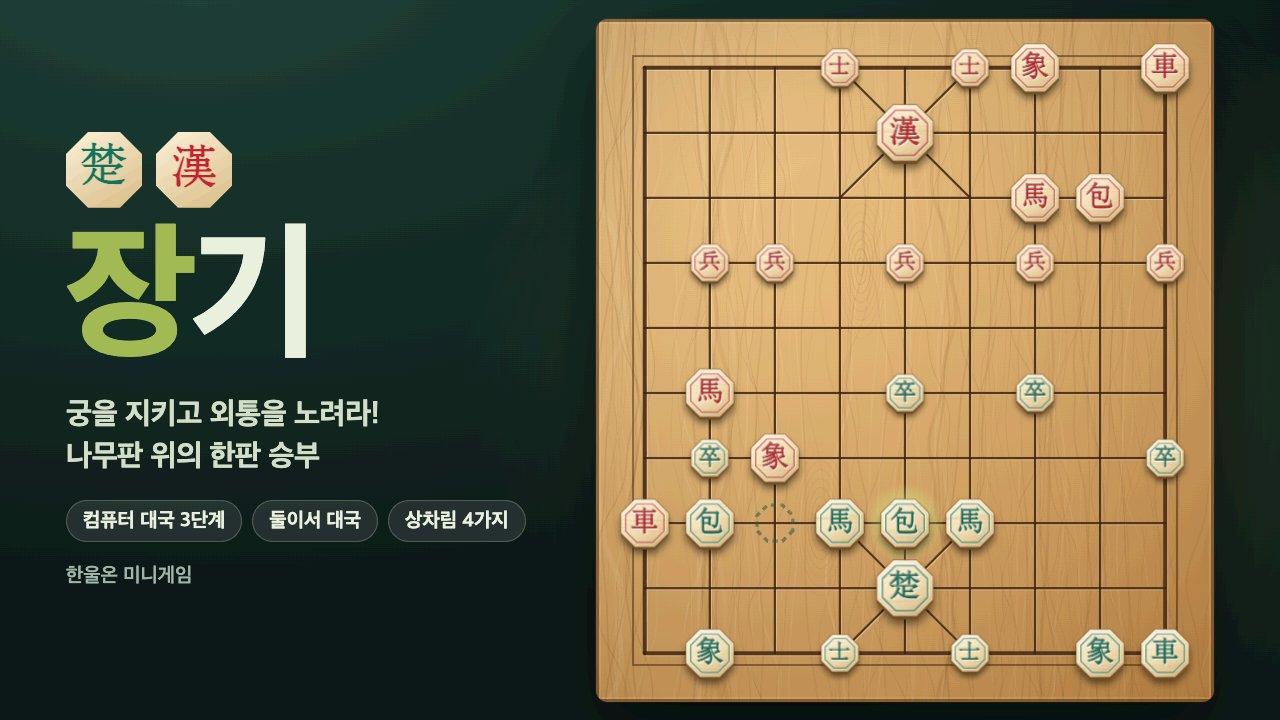
"Janggun!" "Meonggun!" Remember the janggi boards out on neighborhood benches, with onlookers chiming in with advice? Korean chess, where Cho (楚) and Han (漢) maneuver their chariots, cannons, horses, and elephants around their palaces, is a battle of wits that's been loved for generations.
Classic janggi is now on HanulOn. Take on the computer on a wooden board, or sit across from a friend on one device for a head-to-head match. From the opening setup to bikjang, it keeps all the flavor of real janggi.
What kind of game is it?
Cho moves first, and Han follows. Trap your opponent's general so it has nowhere to escape (checkmate) and you win. You can't make a move that would leave your own general to be captured, and if you have no legal moves left, you lose. Attacking the general is janggun (check), and escaping a check while attacking back is meonggun (counter-check).
Opening setup
Before the match, you choose where your horses and elephants go. Han chooses first, then Cho, picking one of these four arrangements from your left:
- Horse-Elephant-Horse-Elephant
- Elephant-Horse-Elephant-Horse
- Horse-Elephant-Elephant-Horse
- Elephant-Horse-Horse-Elephant
How the pieces move
- General and Guards: One step along the lines inside the palace (including diagonals). They can't leave the palace.
- Chariot: Any number of spaces horizontally or vertically. Inside the palace, it can also move diagonally.
- Cannon: Must jump over exactly one piece to move or capture. It can't jump over or capture another cannon. If there's a piece in the center of the palace to jump over, it can also jump diagonally.
- Horse: One step straight, then one step diagonally. It can't move if the straight step is blocked.
- Elephant: One step straight, then two steps diagonally. It can't move if any space it passes through is blocked.
- Soldiers: One step forward or sideways. Inside the enemy palace, they can also move diagonally forward. They can't move backward.
Scoring and rulings
Besides checkmate, there are other ways a game can be decided.
- Piece points: Chariot 13, Cannon 7, Horse 5, Elephant 3, Guard 3, Soldier 2. Han gets a 1.5-point bonus (deom), so Cho starts with 72 points and Han with 73.5.
- Bikjang: When the two generals face each other on the same file with nothing between them. When bikjang is called, the opponent must break it on the very next move by blocking the gap or moving their general; if they don't, the side with more points wins. Orange dots on the board show the spots that would create bikjang.
- Pass: When you're not in check, you can pass your turn once. If both sides pass in a row, the game is decided on points.
- If the same position appears three times, it's a draw.
- Once both sides have made 200 moves combined, the game is decided on points.
Key features
- Play vs. computer: Three levels (Easy, Normal, Hard), and pick your side: Cho (moves first) or Han (moves second)
- Two-player: Take turns on one device
- Undo, Pass, New Game, and Rules buttons
- Shows captured pieces and the current move (out of 200)
Games against the computer count toward your cumulative score on the HanulOn leaderboard.
How to play
- Tap a piece, and dots appear where it can move. Tap a dotted spot to move there.
- Pieces marked with a ring are enemy pieces you can capture.
- Keyboard: Arrow keys to move, Enter or Space to select, Esc to cancel.
Tips
- The chariot is your highest-value piece at 13 points. Don't give it away carelessly; with point rulings in mind, it pays to protect every single piece.
- A cannon needs a piece to jump over in order to move. Remove the screen in front of an enemy cannon to pin it in place.
- Horses and elephants can't move when their path is blocked. Just placing a piece in the path of an enemy horse or elephant makes for good defense.
- If you're ahead on points, try calling bikjang to pressure your opponent. If you're behind, keep a close eye on the orange dots that show bikjang spots.
Who it's for
- Anyone who hasn't played a game of janggi in a while
- Players who want the full official rules, including opening setups and bikjang
- Anyone who wants to sharpen their reading of moves against the computer
Janggun, meonggun! Settle it in a match on the wooden board.